
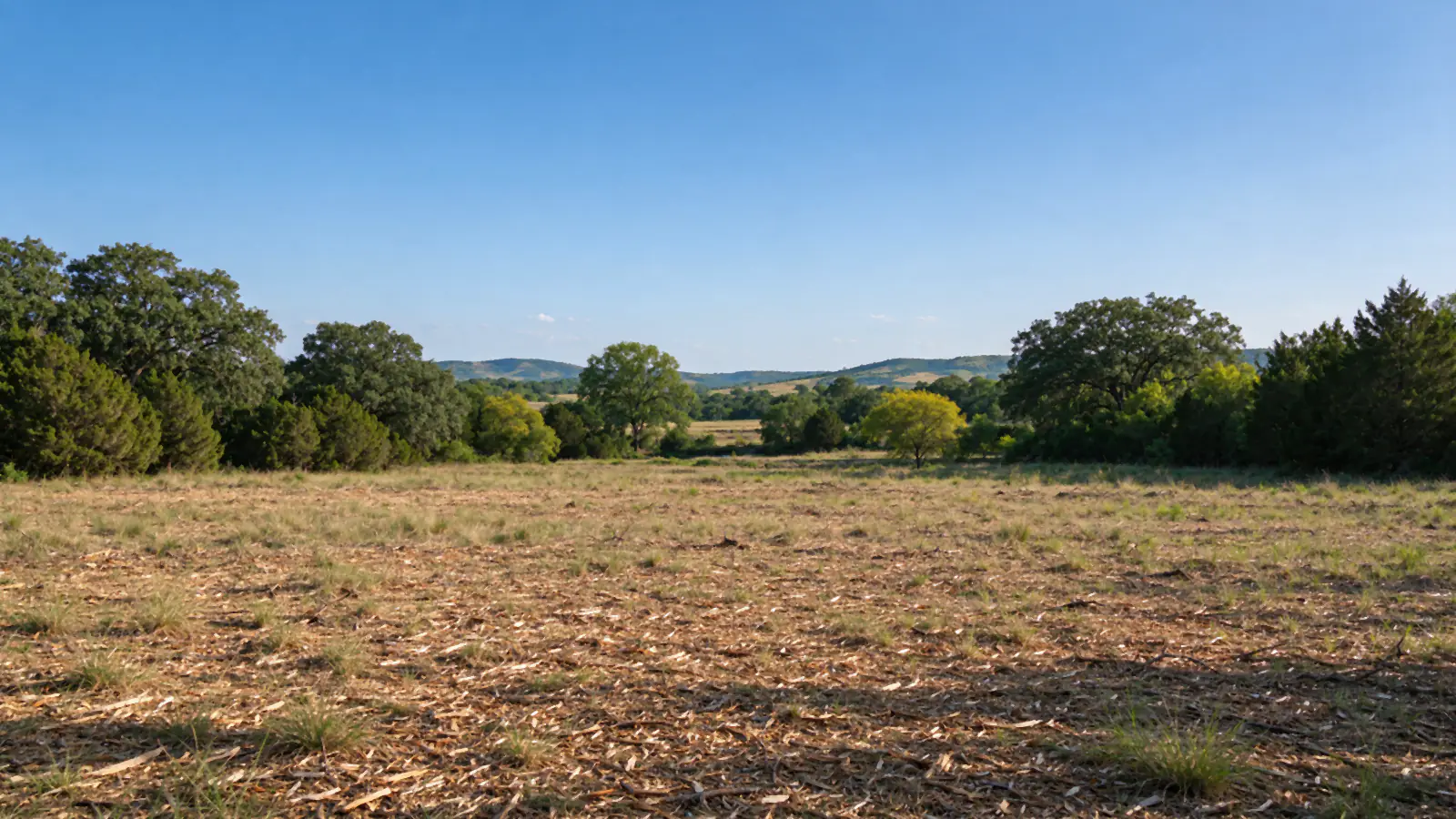
Short answer: most land clearing in Bell County needs no general clearing permit. The rules that matter are about burning, construction stormwater, digging near utilities, protected trees in part of Temple, and, on a small share of tracts, endangered species and oak wilt. Which ones apply depends on the address.
Arcady Temple Land Clearing checks these rules for each tract before work starts. This guide puts them in one place, by who regulates what.
Who regulates what
| Level | What it controls | Where it applies |
|---|---|---|
| City (Temple, Belton, Salado and others) | Outdoor burning, tree rules, debris disposal | Inside city or village limits |
| Bell County | Burn bans, floodplain and platting permits | Unincorporated land |
| State of Texas | Outdoor burning baseline, construction stormwater, 811 locates, ag valuation rollback, ash wood movement | Everywhere in the county |
| Federal | Endangered species habitat, federal lake land | Specific tracts only |
Burning: the rule that changes the most jobs
Burning is where city lines matter most.
Inside Temple
Temple’s city code makes it unlawful to burn trash, brush, tree limbs, trees, leaves or other debris outdoors inside city limits. The exception that matters for clearing allows on-site burning of plant growth from land-clearing operations only when no practical alternative to burning exists, as the state rule allows, and only with a permit from the Fire Marshal first. Recreational fires may not burn yard waste at all. In practice, inside Temple, debris is mulched in place, chipped or hauled. Temple’s code also requires professional tree trimmers to register with the city and haul their cuttings to the landfill or another designated site, rather than leaving them at the curb.
Inside Belton
Belton requires an open burn permit at all times for burning inside the city (see the Belton service area page), $100 for residential and $300 for commercial, and the Fire Marshal inspects the burn area before any burn.
Inside Salado
The Village of Salado’s outdoor burning ordinance issues permits for undeveloped land clearing, storm damage and downed limbs, with strict conditions: brush piles no larger than 20 feet across and 10 feet high, a 20-foot fire break, 300 feet from neighboring buildings, burning only from 7am to sundown, and only when the wind is between 6 and 23 miles an hour. Confirm the current permit process with the village before planning a burn; the Salado page has more on the creek and springs there.
Unincorporated Bell County
Under the state’s outdoor burning rule, a county that is not part of a designated air quality nonattainment area allows land owners to burn trees, brush and plant growth from land clearing on the property where it grew, subject to city-limit bans. Bell County is not designated nonattainment. Only natural vegetation may be burned; the county fire marshal treats burning tires, plastics, rubber, or manufactured or treated wood as a Class A misdemeanor. The county judge issues burn bans in dry spells, as in August and September 2026, so check the county’s burn ban status before lighting anything. The rural Bell County page covers acreage outside the cities.
The guide to burning brush in Bell County compares the options and alternatives in detail.
Construction stormwater: the 1-acre line
When clearing is the first step of a construction project, the Texas Commission on Environmental Quality’s Construction General Permit covers stormwater from any project that disturbs an acre or more, or that is part of a larger common plan that will. Large sites of 5 acres or more file a notice of intent. The permit requires a stormwater pollution prevention plan, which in practice means silt fence and other controls before the ground opens, kept in place until the site is stabilized. On Bell County clay, bare soil sheds sediment fast in a spring storm. The guide on erosion control after clearing covers what that looks like on a lot, and the construction site clearing page covers how clearing and the stormwater plan fit together.
Trees: Temple’s I-35 corridor and oak wilt
Temple’s I-35 corridor overlay
Temple’s development code protects trees over 8 inches in diameter at breast height within the floodplain, plus 300 feet from it, inside the I-35 corridor overlay district. A sealed tree survey and preservation plan comes with the site plan; removed protected trees are replaced inch for inch from the city’s plant list, or a $100 per caliper inch fee goes to the Parks Department where they cannot be replaced on site. No general citywide tree removal permit was found elsewhere in Temple’s development code. Temple has been updating that code since 2023, so the current version is checked per project.
Oak wilt
Oak wilt is documented in 76 Texas counties, mostly west of I-35 from Dallas to San Antonio. Texas A&M Forest Service advises avoiding wounds on oaks from February through June, when sap beetles carry the fungus, and painting any fresh oak wound at any time of year. It lists land and cedar clearing among the activities that create those wounds. Selective clearing near live oaks and red oaks is scheduled around that window. See oak wilt and land clearing.
Not sure which rules hit your tract?
Send the address. City limits, the floodplain and the kind of woodland on it decide which of these apply.
Digging: 811 before grubbing
Texas law treats mechanized digging 16 inches or deeper, including grading, ripping and dragging, as excavation, and requires a call to the Texas811 notification center no earlier than 14 days and no later than 48 hours before it starts, excluding weekends and holidays. Mulching at the surface usually stays above that depth. Pulling stumps, root balls and mesquite crowns usually does not, so grubbing work starts with a locate request. That applies to stump removal by extraction and to grubbing mesquite below its bud zone.
Wildlife and water
Golden-cheeked warbler
The golden-cheeked warbler is a federally endangered songbird that nests only in Central Texas. The U.S. Fish and Wildlife Service describes its habitat as woodland with mature Ashe juniper, at least about 15 feet tall and 5 inches across, mixed with oaks, elms and other hardwoods, often on moist canyon slopes with a nearly closed canopy. Fort Cavazos, in Bell and Coryell counties, supports a breeding population. Federal law treats significant habitat modification that harms the bird as prohibited take. Surveys to show the birds are absent only count from March 15 to June 1. Clearing young cedar spreading into open pasture is a very different situation from clearing mature mixed woodland on a canyon slope. The golden-cheeked warbler guide explains how to tell them apart.
Salado salamander
The Salado salamander, listed as threatened in 2014, lives in springs near the Village of Salado and farther up Salado Creek. The U.S. Fish and Wildlife Service designated critical habitat for it in 2021. For clearing near those springs and the creek, sediment control and setbacks matter more than usual.
Federal lake land
Belton Lake and Stillhouse Hollow Lake are managed by the U.S. Army Corps of Engineers. Federal land around them is not private land, and vegetation work there needs the Corps’ approval. Where a property line falls in relation to that boundary is confirmed per address.
Ash wood and the emerald ash borer
The emerald ash borer was confirmed in Bell County during the 2025 federal fiscal year. State quarantines restrict moving ash material out of quarantined counties, so ash wood from clearing is processed or disposed of here rather than hauled out as logs or firewood.
Ag valuation and property taxes
Clearing brush to improve grazing, the work covered on the pasture clearing page, keeps land in agricultural use. Clearing it for a homesite or another use can be a change of use. Under Texas Tax Code section 23.55, land that loses its open-space agricultural appraisal owes an additional tax equal to the difference for each of the three previous years. Check with the Bell County Appraisal District before clearing a parcel with an ag valuation. See clearing ag land and property taxes.
Debris: where cleared brush is allowed to go
What happens to the brush is decided by the address as much as by the method.
- Mulched on site. Allowed everywhere. Nothing is burned or hauled, so no burn permit applies and nothing goes to the curb.
- Hauled to the landfill. The Temple Landfill at 706 Landfill Road, at the end of East Avenue H east of Loop 363, is operated by Waste Management under a lease with the City of Temple. Non-residents pay a minimum of $58.24 plus a $0.94 state fee per load, every load must be covered and tarped, and a safety vest is required on the site.
- Left at the curb. In Temple, city brush collection is for residents’ own trimmings set within 3 feet of the curb. Contractor-cut debris has to be hauled by the contractor.
- Burned. Only where the city or county rules above allow it, and only natural vegetation.
Floodplains and creeks
Bell County handles floodplain, platting and related permits for unincorporated land through its online permit portal, which the county moved to a new system for projects started from January 2025. Inside Temple, the I-35 corridor overlay’s tree rule applies within the floodplain and 300 feet from it. Clearing along creeks such as Nolan Creek, the Leon River, the Lampasas River and Salado Creek leaves bare soil right where runoff concentrates, so erosion control matters most there.
A calendar of rules that depend on the season
| Window | What changes | Why |
|---|---|---|
| February to June | Avoid wounding oaks | Sap beetles carry oak wilt in late winter and spring |
| March 15 to June 1 | The only window when golden-cheeked warbler surveys count | U.S. Fish and Wildlife Service survey requirements |
| May, and September to October | Wettest months; clay ruts under tracks | NOAA normals for Bell County stations |
| Late summer and early fall | County burn bans most likely | Bans in August and September 2026 |
What clearing does not include
Clearing removes vegetation, and grubbing removes stumps, roots and organic matter. Neither one is grading, fill or compaction, which belong to the dirt contractor or builder, and neither one makes a lot ready for a slab on its own. The guide on how clear a lot needs to be before you build covers that handoff, and the land clearing cost guide shows which of these parts carry a fee.
Who to ask, by question
| Question | Who answers it |
|---|---|
| Can I burn inside Temple? | Temple Fire Marshal’s Office (Temple Fire & Rescue) |
| Can I burn inside Belton? | City of Belton Fire Department, Fire Marshal |
| Can I burn inside Salado? | Village of Salado and the Salado Volunteer Fire Department |
| Is there a county burn ban today? | Bell County Fire Marshal, or the county burn line at 254-933-5555 |
| Where are the buried utilities? | Texas811, at least 48 hours before digging |
| Does my construction site need stormwater coverage? | Texas Commission on Environmental Quality |
| Could my woodland be warbler habitat? | U.S. Fish and Wildlife Service, Austin Ecological Services Field Office |
| Will clearing change my ag valuation? | Bell County Appraisal District |
| Is my oak at risk from oak wilt? | Texas A&M Forest Service |
Can timber pay for the clearing?
Rarely in Bell County. No local market for sawlogs turned up in research for this guide, cedar posts sell for little today, and the emerald ash borer quarantine keeps ash wood in the county. Some owners keep a few cedar posts or firewood for themselves, which is fine, but plan on clearing as a cost rather than a sale.
A checklist before clearing starts
- Find out whether the tract is inside city or village limits.
- Decide what happens to debris: mulch, haul or burn, and check the burn rule for that address.
- If the clearing starts a construction project of an acre or more, confirm who holds the stormwater permit.
- If grubbing is planned, call 811 at least 48 hours ahead.
- Flag oaks you are keeping and plan around February through June.
- If the tract is mature cedar and oak on a canyon slope, settle the warbler question first.
- If the land has an ag valuation, talk to the appraisal district before changing its use.
Questions about a specific address? Call (254) 269-4999 or send the details below.