
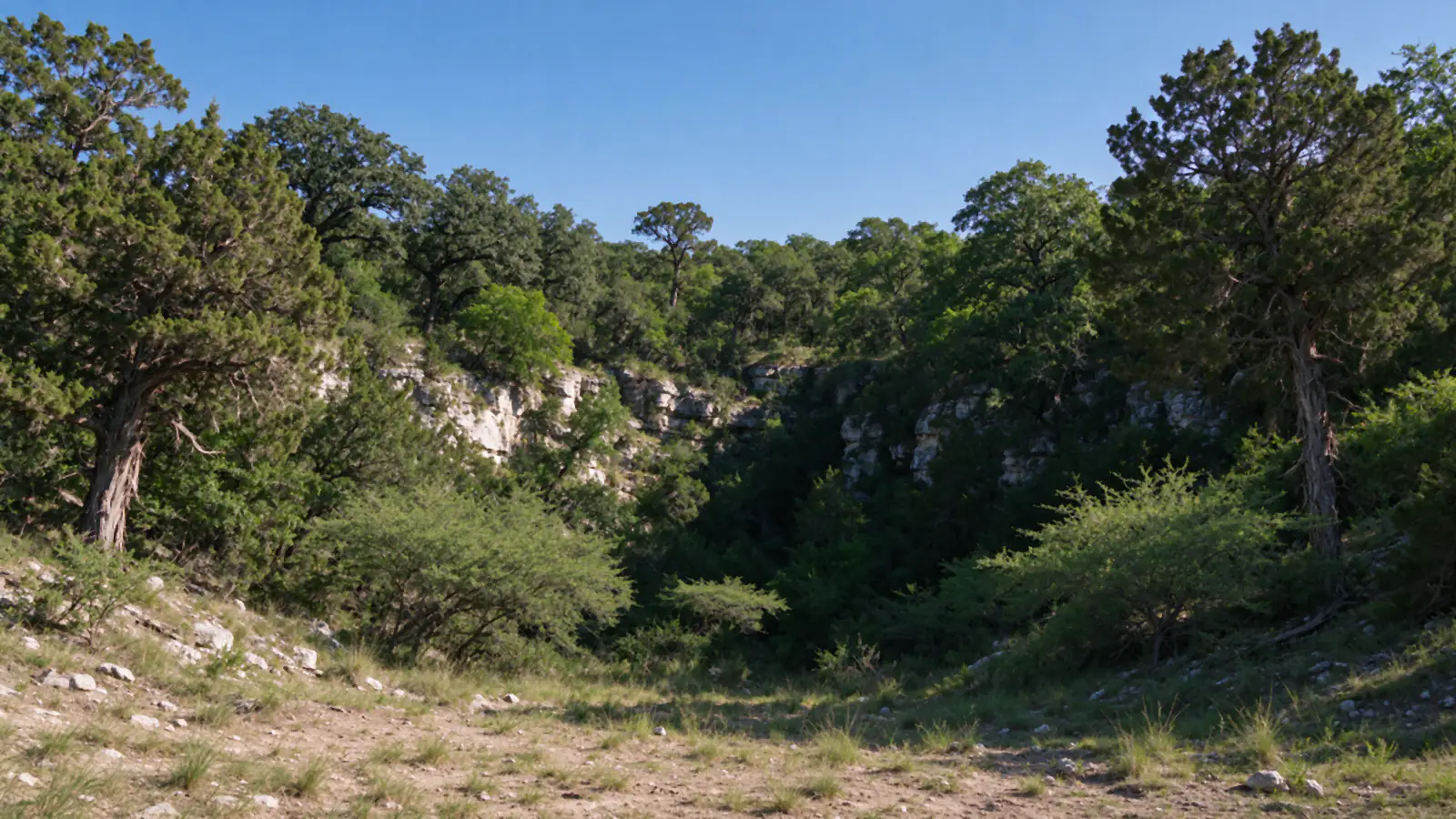
Short answer: for most cedar clearing in Bell County, no. Young cedar spreading into open pasture is not golden-cheeked warbler habitat. The question matters on tracts with mature Ashe juniper mixed with oaks and other hardwoods on steep, moist slopes under a mostly closed canopy, which the U.S. Fish and Wildlife Service describes as the bird’s habitat. On those tracts, settle the question before clearing.
Arcady Temple Land Clearing clears cedar across Bell County and looks at this question on the first walk of any wooded slope.
The bird
The golden-cheeked warbler is a small songbird that nests only in Central Texas and is listed as endangered under the federal Endangered Species Act. It depends on mature Ashe juniper for nesting material: it strips long bark from older trees. Fort Cavazos, which covers parts of Bell and Coryell counties, supports a breeding population.
Federal law prohibits “take” of an endangered species, and the U.S. Fish and Wildlife Service defines harm to include significant habitat modification that kills or injures the bird by impairing breeding, feeding or sheltering. That is why clearing in real habitat is handled carefully.
What habitat looks like
The Fish and Wildlife Service’s Austin office describes potential habitat as:
- mature Ashe juniper, at least about 15 feet tall with trunks around 5 inches across at chest height;
- mixed with oaks, elms and other hardwoods, in a natural mix;
- in moist areas such as steep canyons and slopes, with adjacent uplands also likely used;
- with a nearly continuous canopy, 50 to 100 percent closed, and an overall canopy height of 20 feet or more.
What is usually not habitat
Most cedar clearing in Bell County is young cedar spreading into pasture or open ground: scattered or thick, but small, in full sun, without the tall mixed canopy. That is the work cedar clearing usually describes. Clearing cedar regrowth from a field is a very different situation from clearing a shaded canyon of old cedar and oaks.
| Feature | Young cedar regrowth | Possible warbler habitat |
|---|---|---|
| Tree size | Small to medium | Mature, about 15 ft and 5 in or larger |
| Mix | Mostly cedar | Cedar with oaks, elms, other hardwoods |
| Setting | Open pasture, fence lines | Moist canyons, slopes and adjacent uplands |
| Canopy | Open | 50 to 100 percent closed, 20 ft or taller |
A simple way to read a stand is to stand inside it at midday. If sun reaches the ground, the trees are mostly cedar, and you can see out across the pasture, it is regrowth. If the ground is shaded and cool, oaks and elms are mixed in, and the trees overhead close into a roof well above head height, it is the kind of stand to ask about before any machine goes in. Photos taken from inside the stand, looking up and out, show this better than photos from the road.
Not sure which kind of cedar you have?
Send photos of the stand and the slope. That is the first thing the walk-through looks at.
The survey window
If a tract might be habitat, presence or absence is shown by surveys done under a federal scientific permit. Under the Austin office’s requirements:
- surveys must be done between March 15 and June 1, with at least 60 percent before May 15;
- at least five visits, no more than one in any five-day period;
- in most cases, three years of negative surveys to infer the birds are absent.
That calendar is why the habitat question has to come early. A survey season missed in spring cannot be made up in summer.
How it fits with the rest of the job
Mature cedar-oak woodland usually has oaks worth keeping too, and the oak wilt calendar, February through June, overlaps the survey window. See the oak wilt guide. Clearing that is only young cedar regrowth goes ahead like any other mulching job, and the cedar stays gone, as the guide on whether brush grows back explains.
Who to ask
The U.S. Fish and Wildlife Service’s Austin Ecological Services Field Office handles the golden-cheeked warbler. Its current species range information is published through the Service’s online conservation system. The Bell County rules guide lists the warbler alongside the other rules that can touch a clearing job, and ranch owners should also read clearing ag land and property taxes before a change of use.
Delisting of the warbler has been debated and litigated in recent years. Check the current status with the Service before relying on any older advice.
For a walk-through of a cedar tract, call (254) 269-4999 or send photos below.