
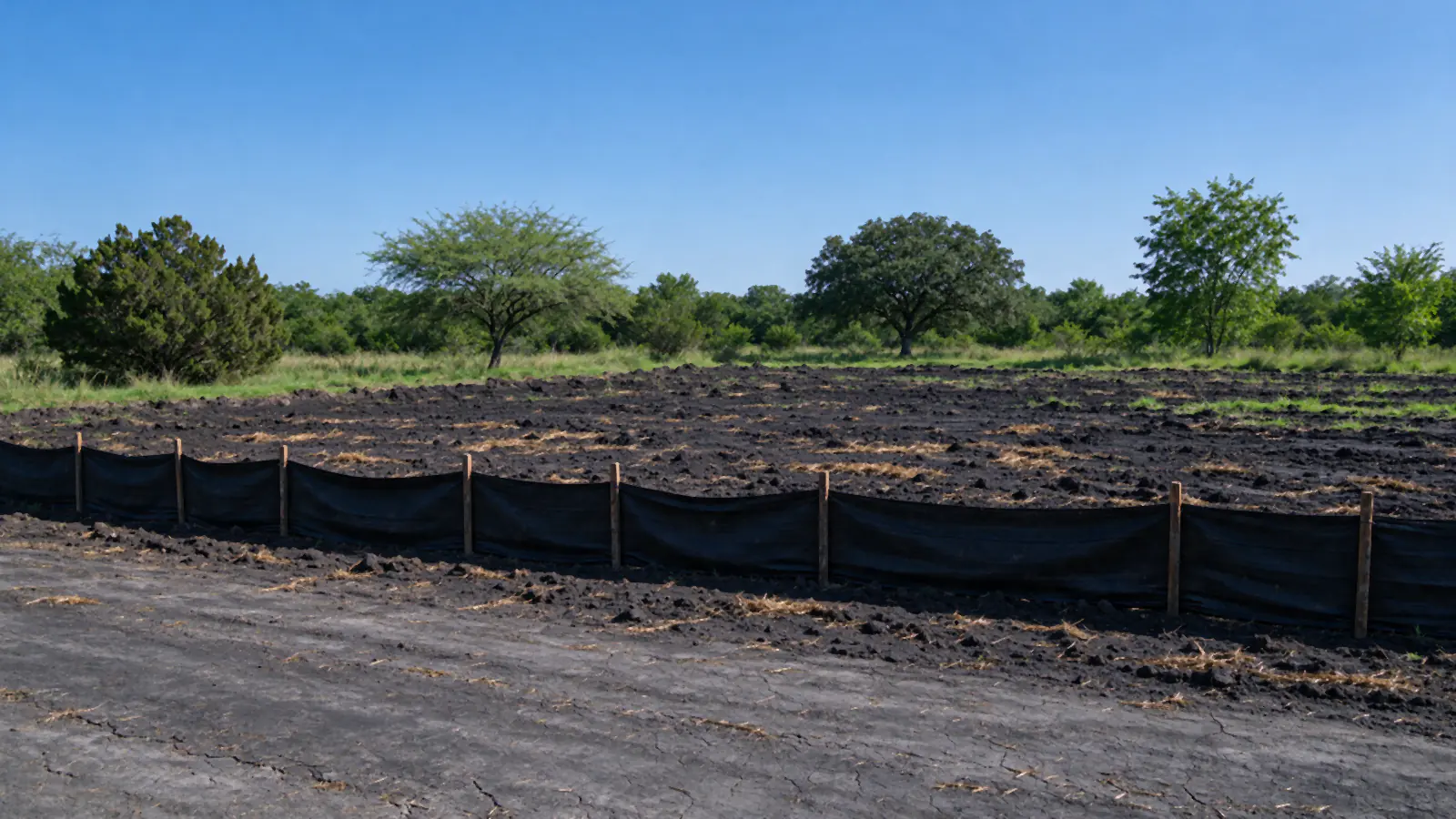
Short answer: if clearing starts a construction project that disturbs an acre or more, the state’s Construction General Permit requires a stormwater plan, which usually means silt fence and other controls before or as the ground opens, kept in place until the site is stabilized. On smaller jobs, erosion control is not required by that permit but is often still worth it, especially on slopes and near creeks.
Arcady Temple Land Clearing plans erosion control alongside the clearing on construction sites and creek-side lots across Bell County.
Why cleared ground erodes
Vegetation does two things for soil: roots hold it, and leaves and litter break the force of rain. Clearing removes both. On Bell County’s clays, bare soil seals at the surface in a heavy rain, water runs off instead of soaking in, and it carries soil with it. On the thin, stony soils west of I-35, slopes wash down to rock.
The method makes a big difference. Forestry mulching leaves roots in place and covers the surface with chips, so mulched ground rarely needs more than care around drainages. Grubbing pulls roots and leaves bare soil, which is why grubbed pads and fields need a plan. The mulching versus grubbing guide compares the two.
When the state permit applies
The Texas Commission on Environmental Quality’s Construction General Permit covers stormwater from construction that disturbs an acre or more, or that is part of a larger common plan of development that will. It requires a stormwater pollution prevention plan. Large sites of 5 acres or more file a notice of intent with TCEQ. The permit belongs to the operator of the project, usually the owner or general contractor, and clearing follows that plan. Construction site clearing covers how the two fit together.
Clearing that is not part of construction, such as clearing brush from a pasture, is not construction activity under that permit. That does not mean erosion is harmless there; it just means the plan is up to you.
Common controls on a cleared site
| Control | What it does | Where it goes |
|---|---|---|
| Silt fence | Slows runoff and traps sediment | Downhill edges of disturbed ground |
| Stabilized construction entrance | Keeps clay off the street | Where trucks leave the site |
| Vegetated buffer | Filters runoff before it reaches water | Along creeks and drainages |
| Mulch or straw cover | Protects bare soil from rain | On grubbed areas awaiting seed |
| Seeding | Permanent cover | All disturbed areas once work is done |
Clearing a site that needs silt fence?
Send the plan. Clearing and erosion control can go in on the same schedule.
What silt fence costs here
On recent TxDOT highway contracts in Bell County, low bids for temporary sediment control fence ran about $3.30 to $5.90 a foot to install and $1.00 to $1.70 a foot to remove. Those are large highway quantities; short runs on a single lot usually cost more per foot. The land clearing cost guide shows how erosion control fits into a clearing price.
Timing and weather
Bell County’s wettest months are May and September through October. A grubbed pad or field left bare through either stretch is at the most risk. The usual approach is to put controls in before grubbing, clear in sections so less ground is bare at once, hand off quickly to the dirt contractor on a homesite, and seed bare pasture ahead of the fall rains. The guide on clearing after rain on black clay covers working around wet ground.
Creeks, springs and the Salado salamander
Sediment matters most where it reaches water. Around Salado, Salado Creek and its springs are home to the Salado salamander, listed as threatened in 2014, with critical habitat designated in 2021. Clearing near the creek there leaves a buffer along the bank and puts controls in first. The Bell County rules guide covers federal protections and floodplain permits.
On a homesite
Even on a lot well under an acre, a short run of silt fence on the downhill side of a grubbed pad keeps clay out of the street and the neighbor’s yard during a storm, and it is cheap compared with cleaning up afterward. The guide on how clear a lot needs to be before you build covers the rest of the handoff to your builder.
For a clearing plan with erosion control, call (254) 269-4999 or send the details below.