
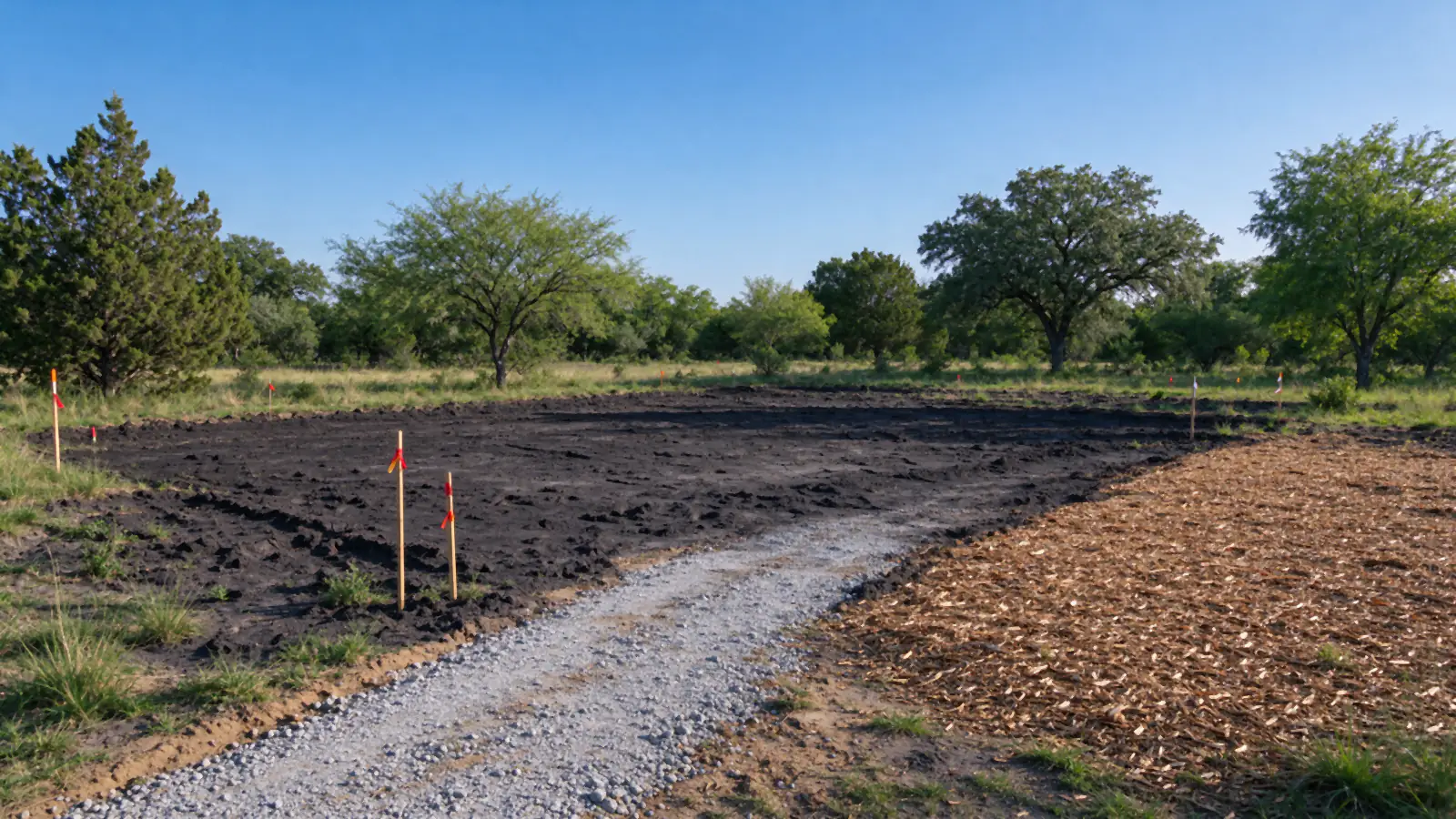
Short answer: a lot is ready for the builder when the house footprint, a working margin around it and the driveway are free of trees, stumps, root mass and debris, with survey stakes still standing. It is not ready for a slab until the dirt contractor has stripped, filled, compacted and graded the pad. Clearing gets you to the first point; your builder takes it to the second.
Arcady Temple Land Clearing clears homesites for owners and builders across Bell County, and this is the handoff question that comes up most.
Where clearing ends and dirt work begins
| Step | Who usually does it | What it leaves |
|---|---|---|
| Clearing | Clearing contractor | Trees and brush gone |
| Grubbing | Clearing contractor | Stumps, roots and organic matter out of the pad and drive |
| Topsoil stripping | Either, per the builder | Organic soil removed and stockpiled |
| Fill and compaction | Dirt contractor | A built-up, tested pad |
| Grading and drainage | Dirt contractor or builder | Water directed away from the house |
The handoff point matters because “build-ready” means different things to different people. A clearing estimate that promises a build-ready lot without grading, fill and compaction is promising something it does not include. Lot clearing covers the clearing side in detail.
Why the pad needs grubbing
Roots and organic soil left under a slab rot and compress over the years, leaving soft spots and voids that settle. On the shrink-swell clays common in Bell County, that settling adds to movement the soil already causes. So the footprint and driveway are grubbed: stumps and root balls pulled, roots removed, holes filled. The stump grinding versus removal guide explains why grinding is not enough under concrete.
Why the rest of the lot usually is not
Outside the footprint, roots in the ground are useful. They hold soil while grass comes back, and keeping trees adds shade and value. The usual plan is to mulch brush outside the envelope, grind stumps in the yard, and protect a few good trees. The mulching versus grubbing guide explains the split.
Have a site plan from your builder?
Send it with the address. The pad, drive and setbacks show exactly what to grub.
What to settle with your builder first
- The staked footprint. Where the slab and drive actually go, on the ground.
- Working margin. How much room around the slab the builder needs for forms, trucks and a pump.
- Topsoil. Strip and stockpile during clearing, or leave it for the dirt crew?
- Driveway. Width, route, and whether it gets base or concrete.
- Utilities. Where water, septic and electric will run, and where existing private lines are. Grubbing deeper than 16 inches needs a Texas811 locate.
- Gate and access. Where the machine unloads now, and where concrete and lumber trucks will enter later, so the same route serves both.
- Trees to keep. Which ones the builder thinks will survive construction, and which will not.
- Timing. How long between clearing and the dirt crew; bare clay sitting through a rainy month washes and ruts.
Bell County ground and timing
On the deep clays around Temple and Troy, a grubbed pad that sits through the May or fall rains turns to mud and ruts under trucks. Clearing close to the dirt contractor’s start date avoids that, as does a little silt fence on the low side. The guide on clearing after rain on black clay covers how to judge the ground. On the stony soils west of I-35, rock near the surface may mean the dirt contractor has rock work to do as well.
Rules that can apply to a homesite
- Temple: contractor-cut debris goes to the landfill, not the curb; burning needs a Fire Marshal permit; trees over 8 inches near the floodplain in the I-35 corridor overlay are protected.
- Belton: burning needs a permit and inspection.
- Construction of an acre or more: the state construction stormwater permit applies. See erosion control after clearing.
- Ag-valued land: building a house can be a change of use with a rollback tax. Ask the appraisal district first.
What to look for in the estimate
A good lot-clearing estimate names the grubbed area, the mulched area, the trees kept, what happens to debris, and what is excluded, especially grading and fill. The estimate checklist has the full list.
To plan clearing for a homesite, call (254) 269-4999 or send the site plan below.