
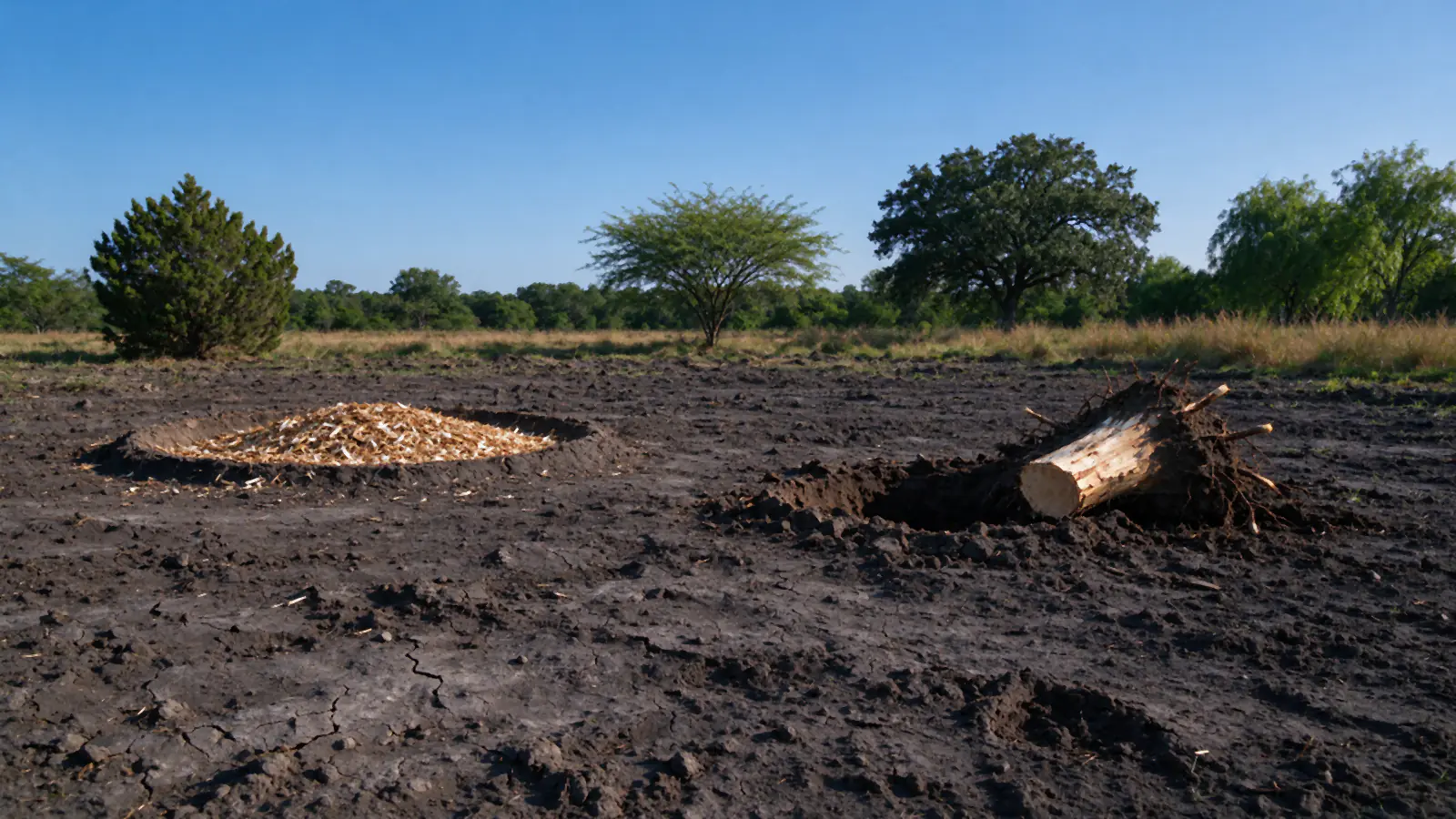
Short answer: grind the stump if the spot will be lawn, pasture, garden or fence line; pull it out with its root ball if anything that carries weight will go over it, such as a slab, driveway, shop or pond bank. Mesquite is the exception to watch: a shallow grind leaves its buds, so it comes back unless ground below the bud zone or pulled.
Arcady Temple Land Clearing arranges both grinding and extraction across Bell County, and the choice is made spot by spot.
What each one does
| Question | Grinding | Extraction |
|---|---|---|
| Depth | Several inches below grade | Stump and root ball out |
| Roots | Stay and rot | Main roots removed |
| Ground disturbance | Low | A hole to backfill |
| Mess | Chips in and around the hole | Soil and a heavy root ball |
| 811 locate | Usually not needed at grinding depth | Needed for digging 16 inches or deeper |
| Good for | Lawns, pastures, gardens, fence lines | Slabs, driveways, pads, pond banks |
Why concrete needs extraction
A ground stump leaves a mass of wood and roots under the surface. As it rots, the ground above it settles, slowly and unevenly. Under grass that just means a shallow dip to top up. Under a slab or driveway it means a void, and on Bell County’s shrink-swell clays that adds to the movement the soil already causes. That is why builders want stumps and root balls out of the pad and driveway, as covered in the guide on how clear a lot needs to be before you build.
Why grinding is better everywhere else
Grinding disturbs very little soil, leaves no big hole, and is usually cheaper for a few stumps. The chips can stay as mulch or be raked out. For a yard, a pasture or a fence line, the roots rotting underground do no harm, and they hold the soil while grass fills in.
Stumps where a driveway is going?
Send a count, rough sizes and what goes over them. That decides grind or pull.
Species: mesquite and cedar
- Mesquite is the stump that fools people. Its regrowth comes from a band of buds around the base, partly underground, and a grinder that stops a few inches down leaves that band intact. Months later the spot sends up a fistful of thorny shoots. For mesquite the grinder has to chew down past the buds, around 14 inches, or the excavator pulls the whole thing. Why mesquite comes back explains the biology.
- Cedar is the easy one. A juniper stump flush with the ground has nothing left that can sprout, so an ordinary grind finishes it.
- Hardwoods such as hackberry and elm sprout from the stump and roots; a grind followed by mowing handles most of them.
The 811 rule
Pulling a stump with its root ball almost always goes deep enough to count as excavation under state law, so the locate request goes in at least two business days before the machine arrives (the window and depth are in the FAQ above). A grinder normally stays shallower than that, though a call still makes sense when a gas or water line is known to run close by. On rural lots, private lines such as a water line to a barn or electric to a well pump are not marked by locators, so ask where they run. The Bell County rules guide covers the rest of the rules that touch digging.
Rock and clay
East of the interstate, on the black clay, a root ball comes out cleanest a few days after rain, when the soil has give but is not mud; the hole then gets backfilled in layers and packed, because a loose fill on clay turns into a puddle. West of the interstate, toward Belton and Harker Heights, the bucket often finds rock a foot or two down, and a hackberry or oak that has wrapped its roots over a limestone shelf can take several times as long to free.
After mulching or earlier clearing
Many stump questions come after the fact: a lot that was mulched, which leaves stumps at grade, now needs a driveway. The same rule applies. If it will carry weight, pull the stumps under it. The mulching versus grubbing guide explains the difference, and stump removal covers how the work is done.
Cost drivers
A grinding quote mostly counts stumps and measures across them. Extraction is quoted more like excavation: hours on the machine, how big the root balls are, and how much fill the holes take. Diameter, species, number, access, rock and whether debris is hauled all move the price. The land clearing cost guide shows how those parts fit together.
For a stump plan, call (254) 269-4999 or send photos below.