
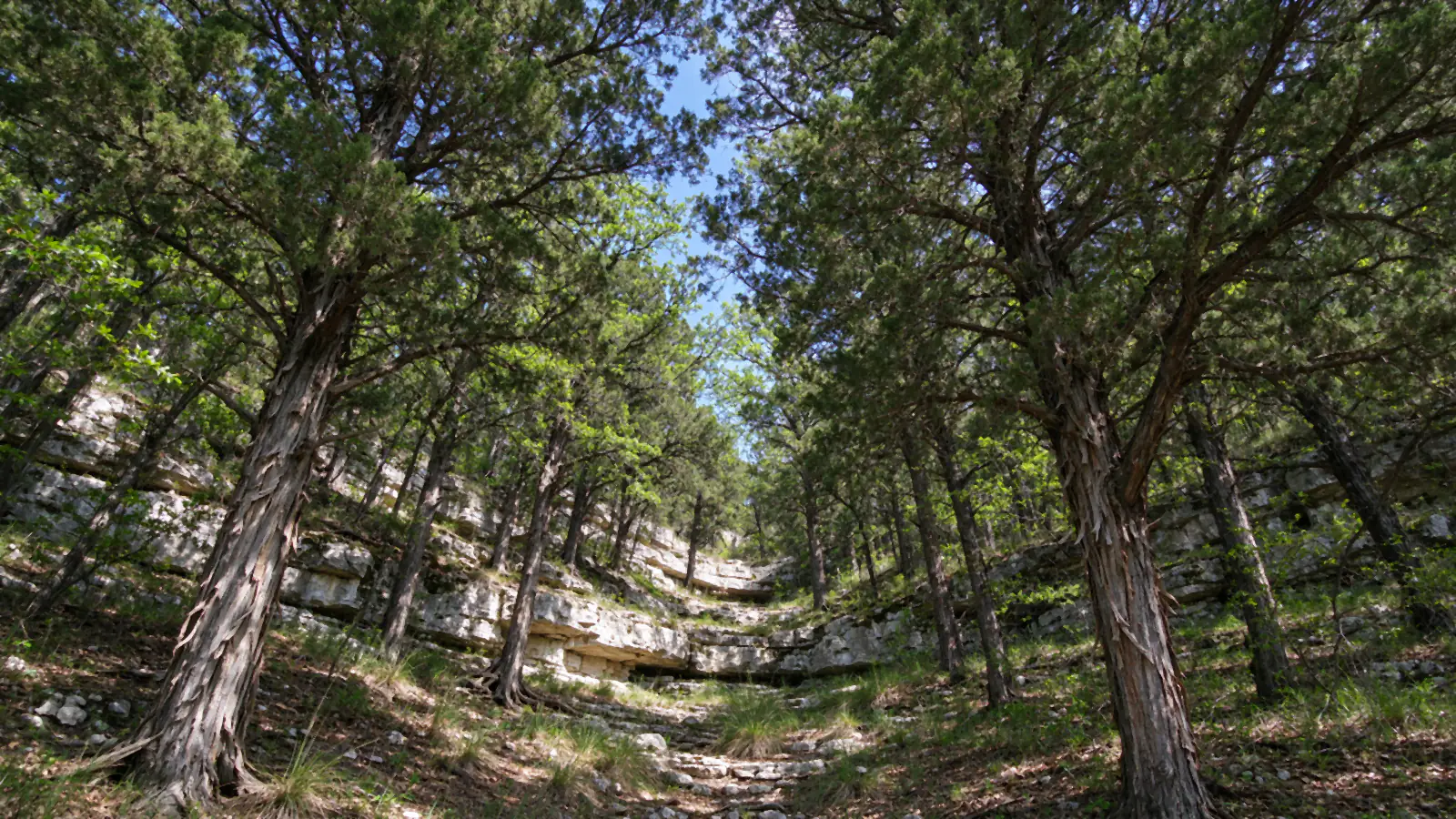
Short answer: golden-cheeked warbler surveys only count between March 15 and June 1 each year, and showing the birds are absent usually takes three seasons of them. Owners of mature cedar and oak tracts who may want to clear should sort out the habitat question in fall and winter, so that if surveys are needed, the first one happens the spring it can, not a year later.
Arcady Temple Land Clearing looks at this on the first walk of any wooded slope in Bell County, because the calendar can decide when a job is possible at all.
Why the dates never move
The golden-cheeked warbler winters far south of Texas and returns to Central Texas only to nest. Males sing on territory through spring, and that is when a trained surveyor can find them. The U.S. Fish and Wildlife Service’s Austin office sets the survey season to match: visits count only from March 15 to June 1, with most of them before May 15, at least five visits in a season, and no two within five days. Outside that window, a walk through the woods says nothing either way. Even inside it, a survey is only as good as the person running it, which is why the Service requires a surveyor who holds the right federal permit rather than an owner with binoculars.
Because three years of negative surveys are generally needed to infer the bird is absent, the calendar for a mature tract is measured in springs, not weeks.
A year on a mature cedar tract
September to December. Walk the land. Most cedar in Bell County is young regrowth on pasture and fence lines, and that clearing goes ahead normally. If part of the tract is tall cedar mixed with oaks and elms on a shaded slope, mark it and take photos from inside it. The warbler and cedar clearing guide describes what the Service counts as habitat.
January and February. If a stand might be habitat, contact a biologist with the federal permit for warbler surveys and get on the calendar before spring fills up. Clearing of open pasture cedar elsewhere on the tract can happen now.
March 15 to June 1. Surveys run, if needed. This overlaps the February to June oak wilt season, so clearing near oaks is limited anyway. See the oak wilt guide.
Summer. Survey results guide the next step. The U.S. Fish and Wildlife Service’s Austin Ecological Services Field Office is the agency to talk with about anything beyond that.
Mature cedar on a slope you want cleared?
Send photos taken from inside the stand. Winter is the time to sort out whether it needs a survey.
What can go ahead regardless
Clearing young cedar out of open pasture, along fence lines and around a house is not tied to the warbler window. Cedar clearing on those parts of a tract can be scheduled for whenever the ground and burn rules suit, and cedar cut below its lowest green limb stays gone, as the guide on whether brush grows back explains.
Why waiting costs a year
The window closes on June 1. A tract owner who decides in July that surveys are needed has lost that spring, and the earliest first visit is the next March. That is why the habitat question belongs at the start of a plan, alongside the other rules in the Bell County rules guide.
Status changes
The warbler’s listing has been debated and taken to court in recent years. Check the bird’s current status and survey rules with the Service each season rather than relying on what applied last year.
For a walk-through of a cedar tract before spring, call (254) 269-4999 or send photos below.