
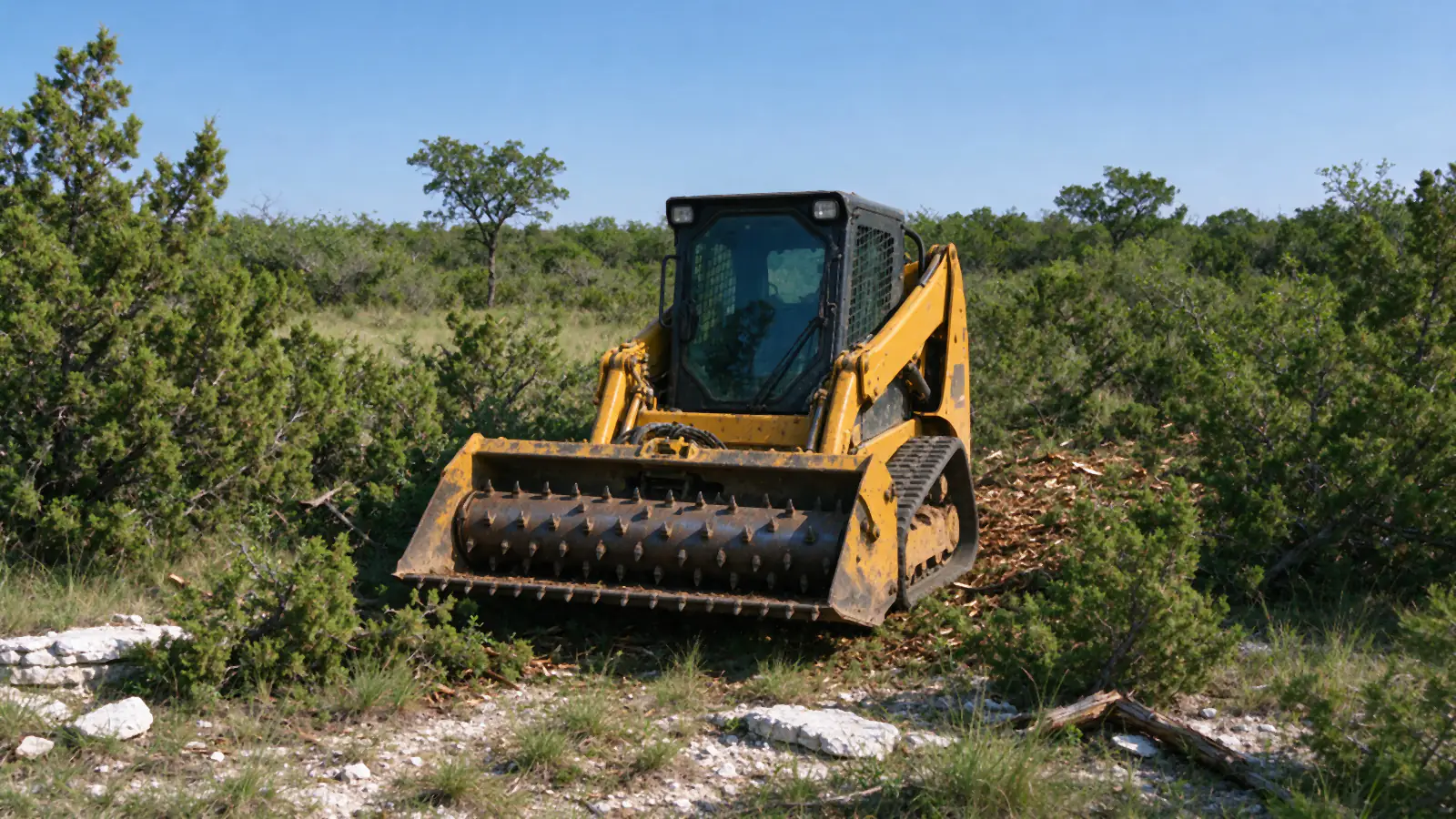
Short answer: in light brush, a forestry mulcher can clear well over an acre in a day; in thick cedar on rock, one acre can take a full day or more. Grubbing stumps and roots takes longer than mulching, hauling debris adds time, and on Bell County clay, rain can stop work for days. The machine day, not the acre, is usually the real unit of time.
Arcady Temple Land Clearing builds every schedule from these factors, and the same factors set the price.
What sets the pace
| Factor | Faster | Slower |
|---|---|---|
| Growth | Brush and saplings | Dense cedar, trunks over 8 inches |
| Ground | Deep soil, dry | Rock near the surface, wet clay |
| Slope | Flat | Steep, with hand cutting |
| Finish | Mulched at grade | Grubbed, stumps pulled |
| Debris | Left as mulch | Hauled or piled for burning |
| Keepers | None | Many trees to work around |
| Hidden debris | Clean | Old wire, concrete, trash |
Growth and trunk size
A mulcher moves quickly through brush and young cedar, because each pass grinds through small stems. Once trunks pass about 8 inches across, it slows down sharply, and a handful of big trees can take as long as a whole acre of brush. That is why two acres that look similar from the road can take very different times.
Rock and slope
On the stony soils west of I-35, around Belton’s west side, Harker Heights and Nolanville, rock near the surface slows the mulching head, wears its teeth, and can force hand cutting on steep or rocky ground. On deep soils east of I-35, rock is rarely an issue.
Grubbing and debris
Forestry mulching does everything in one pass. Clearing and grubbing takes several: cutting, pulling stumps and root balls, filling holes, and moving debris to a pile, a truck or a burn site. Hauling to the landfill adds trips. The mulching versus grubbing guide compares the two.
Working to a deadline?
Tell us the date the land has to be ready. The schedule is planned around density, ground and weather.
Keeper trees and hidden debris
Two items in the table above are easy to miss on a walk-through. Every tree an owner wants to keep slows the machine: the operator works up to it carefully, and the last few feet are often cut by hand, so a lot with a dozen keepers takes noticeably longer than one cleared edge to edge. Hidden debris is worse. Old fence rows, home sites and dump spots on rural tracts hide barbed wire, T-posts, buried concrete and car parts. Wire wraps around a mulching head and stops it; concrete breaks teeth. Finding and pulling that material by hand before the machine passes adds time, which is why the walk-through looks for old fence lines and spots where trash was piled.
Weather on Bell County clay
On the deep clays around Temple, Troy and Holland, crews avoid working saturated ground, because tracks rut it and the ruts dry hard. After a soaking rain that can mean waiting several days. Bell County’s wettest months are May and September through October, so jobs in those stretches carry more weather risk. The guide on clearing after rain on black clay explains how to judge the ground.
Small lots and machine days
On a small residential lot, the clearing itself may take only part of a day, but the job still takes a machine day: loading, hauling the machine to the site, unloading, working, cleaning up and leaving. That is why small jobs are priced around a machine day, about $3,000 to $4,000 in typical Central Texas ranges. The land clearing cost guide explains how time turns into price.
Linear jobs
Fence lines, trails and driveway corridors are measured in length rather than acres. A long, straight rural line with open approaches goes quickly; a short suburban strip with sheds and trees close by is slower per foot. The guide on how wide to clear a fence line covers what the width does to the time.
What a schedule should show
A clear estimate gives a start window, a working estimate in days, and what happens if it rains. The estimate checklist lists the rest.
For a timeline on your land, call (254) 269-4999 or send the details below.